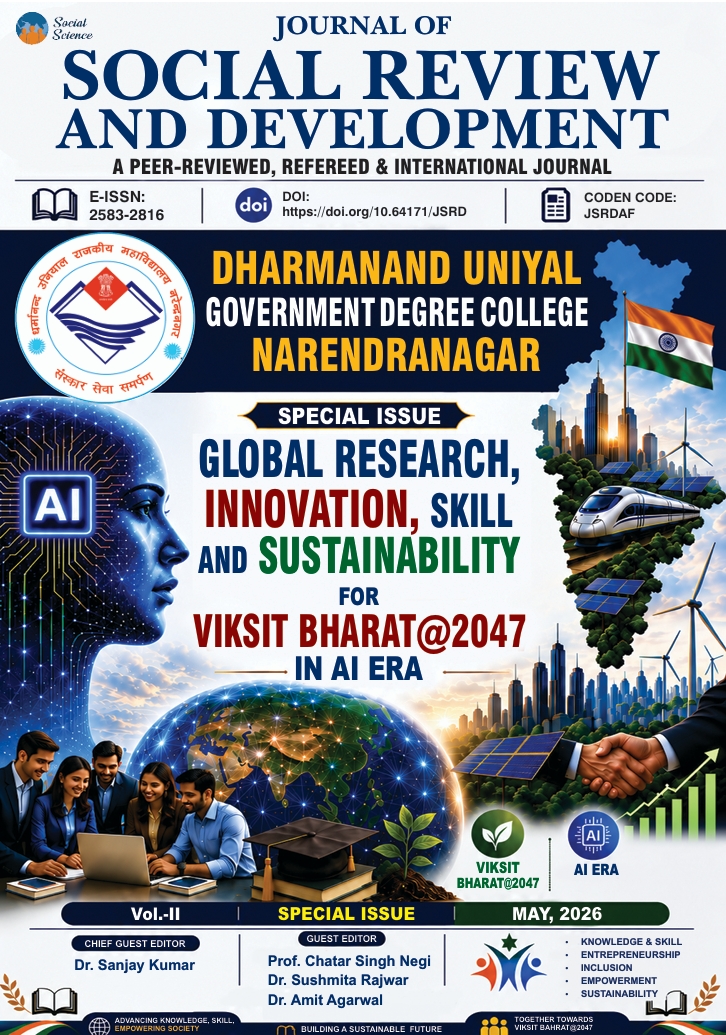
Conceptualizing developed India 2047: A strategic framework for long-term national transformation
DOI:
https://doi.org/10.64171/JSRD.5.S2.64-72Keywords:
Developed India 2047, Long-term strategic planning, Adaptive and flexible goal setting, Policy implementation and coordination, Technological transformation and governance, Generational commitmentAbstract
The vision of a developed India by 2047, marking one hundred years of independence, encompasses within it both possibilities and challenges. Although nearly two decades remain to achieve this objective, if efforts during this period are not implemented in a systematic and organized manner, this vision may, like earlier aspirations, remain merely an unrealized dream. The attainment of any long-term objective requires, first and foremost, careful attention to the fundamental points upon which it is based. At the core of this concept lie four foundational pillars, each of which is significant; however, they must be carried forward collectively and in coordination. In the process of planning for goal attainment, certain deficiencies often emerge. The pace of technological transformation, in particular, is rapidly reshaping economic, social, political, cultural, and global conditions. With the advent of artificial intelligence, this accelerated transformation is evident and requires no further justification. While determining goals, it is essential that they be clear, attainable, and flexible enough to incorporate changes necessitated by evolving circumstances. As we stand at the present juncture contemplating the future, we must also recognize the distinction between those who envision the dream and those who may witness its realization. The current generation that dreams of this transformation may not necessarily see its full materialization; however, this does not diminish their responsibility to contribute. The realization of this vision demands greater dedication from the present generation so that future generations may acknowledge and appreciate these efforts.
Simultaneously, persistent issues such as poverty, education, healthcare, and the condition of farmers continue to challenge the trajectory of progress, raising questions about earlier initiatives. Past efforts should not be dismissed outright; rather, they should be evaluated critically, acknowledging their shortcomings and strengthening the latent possibilities for advancement. Any plan, regardless of how well it is articulated on paper, yields no benefit unless it assumes concrete form. Policymakers and implementers must understand and respect each other’s perspectives. Unless a positive and progressive mindset permeates all stakeholders, policies will fail to reach their intended objectives.
By adopting a prudent and farsighted approach, emerging challenges can be identified in a timely manner and addressed effectively. Long-term objectives should be conceptualized through the achievement of successive short-term goals. Just as a long journey is incomplete without intermediate milestones, it is necessary to pause, reflect, and rectify deficiencies at each stage. While pride in national capabilities is justified, awareness of limitations is equally essential. Ignoring shortcomings cannot lead to progress. Change in mindset must not be superficial but genuinely oriented toward goal attainment. A structured managerial approach can effectively and efficiently guide the realization of defined objectives. Through coordinated efforts across diverse sectors, the goal of a developed India by 2047 can be achieved in a phased and systematic manner.
References
Aghion P, Antonin C, Bunel S. The power of creative destruction. Cambridge (MA): Harvard University Press, 2021.
Barro RJ. Education and economic growth. World Development. 2013;40(3):235-246.
Mehrotra S. India's demographic dividend: opportunity or challenge? Economic and Political Weekly. 2014;49(14):43-51.
Rodrik D. One economics, many recipes: globalization, institutions and economic growth. Princeton (NJ): Princeton University Press, 2007.
Sen A. Development as freedom. New Delhi: Oxford University Press, 1999.
Stiglitz JE. Making globalization work. New York: W. W. Norton & Company, 2007.
Schwab K. The Fourth Industrial Revolution. New York: Crown Publishing, 2016.
World Bank. World development report. Washington (DC): World Bank, 2022.
United Nations Development Programme. Human development report. New York: UNDP, 2013.
NITI Aayog. Vision for developed India 2047. New Delhi: Government of India, 2023.
United Nations Environment Programme. Global environment outlook. Nairobi: UNEP, 2021.
World Health Organization. Global health observatory report. Geneva: WHO, 2022.
World Bank. Poverty and shared prosperity report. Washington (DC): World Bank, 2023.
United Nations Development Programme. Human development report 2023/2024. New York: UNDP, 2023.
NITI Aayog. Strategy for New India @75 and vision for Developed India 2047. New Delhi: Government of India, 2023.
World Health Organization. Global health observatory data repository. Geneva: WHO, 2022.
Food and Agriculture Organization. The state of food and agriculture. Rome: FAO, 2023.